Does Anybody Know What Time It Is?
Metaphorically, it’s 11:26 PM


It’s that time again. For the past nine years, I have participated in the annual Asahi Glass Questionnaire on Environmental Problems and the Survival of Humankind.
For over three decades, dating back to the landmark 1992 Earth Summit in Rio, the Asahi Glass Foundation has consistently administered its annual environmental survey. The global questionnaire focuses on assessing humanity’s prospects for survival and the health of our planet in light of the social and environmental challenges of the 21st century. The questionnaire aggregates the responses from a network of government, private-sector, and media experts to a specific time on the “Environmental Doomsday Clock,” similar to the one used by the Bulletin of the Atomic Scientists (incidentally, I am still more optimistic than the Bulletin, whose clock sits dangerously close to midnight.
One can argue the utility of such surveys, or at least the use of the word “doomsday” in their mechanism. I believe the exercise of collecting thoughts, insights, and opinions from across sectors and continents helps us all see beyond our silos. It illuminates potential paths with a clear-eyed understanding of where we are now and what we must do to build the robust, cooperative alliances necessary to secure a sustainable future for all.
Edging Toward Midnight
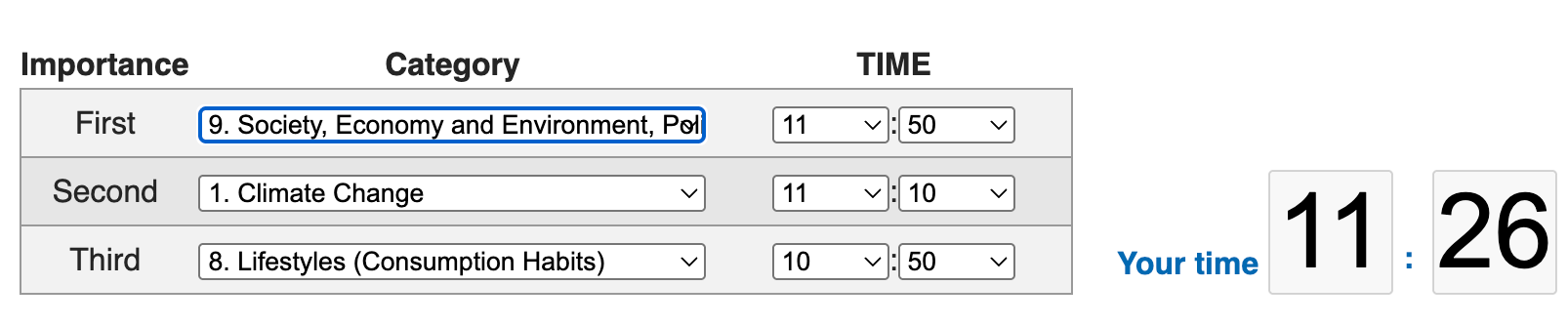
I listed the three most pressing concerns for the United States as “climate change,” “consumption habits,” and “Society, Economy, Environment, and Policies.” Of those, I ranked society, economy, environment, and policies as the most urgent.
Here’s why:
Without honest governance, without a reliable and trustworthy media landscape, without stable institutions, forging a sustainable and equitable future given the challenges before us is all but impossible. The solutions to all other issues highlighted in the survey, from climate change and biochemical flows to consumption patterns, food, water, and biodiversity, flow from competent, empathetic leadership and sound policymaking.
This is currently lacking in America, particularly at the national level, threatening a stable climate, environmental stewardship, social justice, science, and democracy itself.
The Trump administration has hobbled America’s leadership role in science and climate action.
President Trump is actively hostile toward renewable energy, instead doubling down on coal and fossil energy even as the rest of the world is largely moving on.
Being skeptical of anthropogenic climate change isn’t enough for Mr. Trump. He must insist it is a “scam,” a “hoax,” the greatest ever perpetrated on humankind. He has no interest in understanding the reality of climate change (among many other things).
For the Trump regime, the planet is little more than a warehouse of resources to be extracted, cut down, dug up, killed, and flattened. People are only useful to the degree that they are loyal to a cult of personality. This rhetoric, mass psychosis of his most hardcore followers, and the resulting policies make good governance, or the lack thereof, the most critical challenge for realizing progress toward an equitable, thriving, and sustainable future.